
Cheap debt and multiple expansion no longer carry private equity returns. Value now has to be built by operators, which makes leadership the decisive lever. Yet CEO change is the norm, and few investors trust their own ability to assess leaders.
The old engines of return are running out
For a decade, private equity could rely on leverage and rising valuation multiples to do much of the heavy lifting. That era is ending.
• Holds are longer. The average holding period at exit is now around seven years, with some 32,000 unsold companies worth $3.8 trillion awaiting exit (Bain & Company, 2026).
• Multiples have stopped helping. Multiple expansion contributed an average of 58% of the value created in sponsor-backed companies between 2017 and 2022 (DealEdge and Wellington, cited by PEI). That lever is now fading.
• Operations are what is left. McKinsey, drawing on StepStone data, finds 41% of 2010–22 buyout returns came from revenue growth and margin expansion, and describes leverage and multiples as “largely spent”. EY-Parthenon attributes around 42% of private equity’s additional return over public benchmarks to strategic and operational improvement.
Bain’s conclusion is that the winners will “invest in talent… and move from full potential diligence to execution on Day 1”. Value must now be built inside the business, and that means it will be built, or lost, by the people who run it.
Leadership change is the norm, not the exception
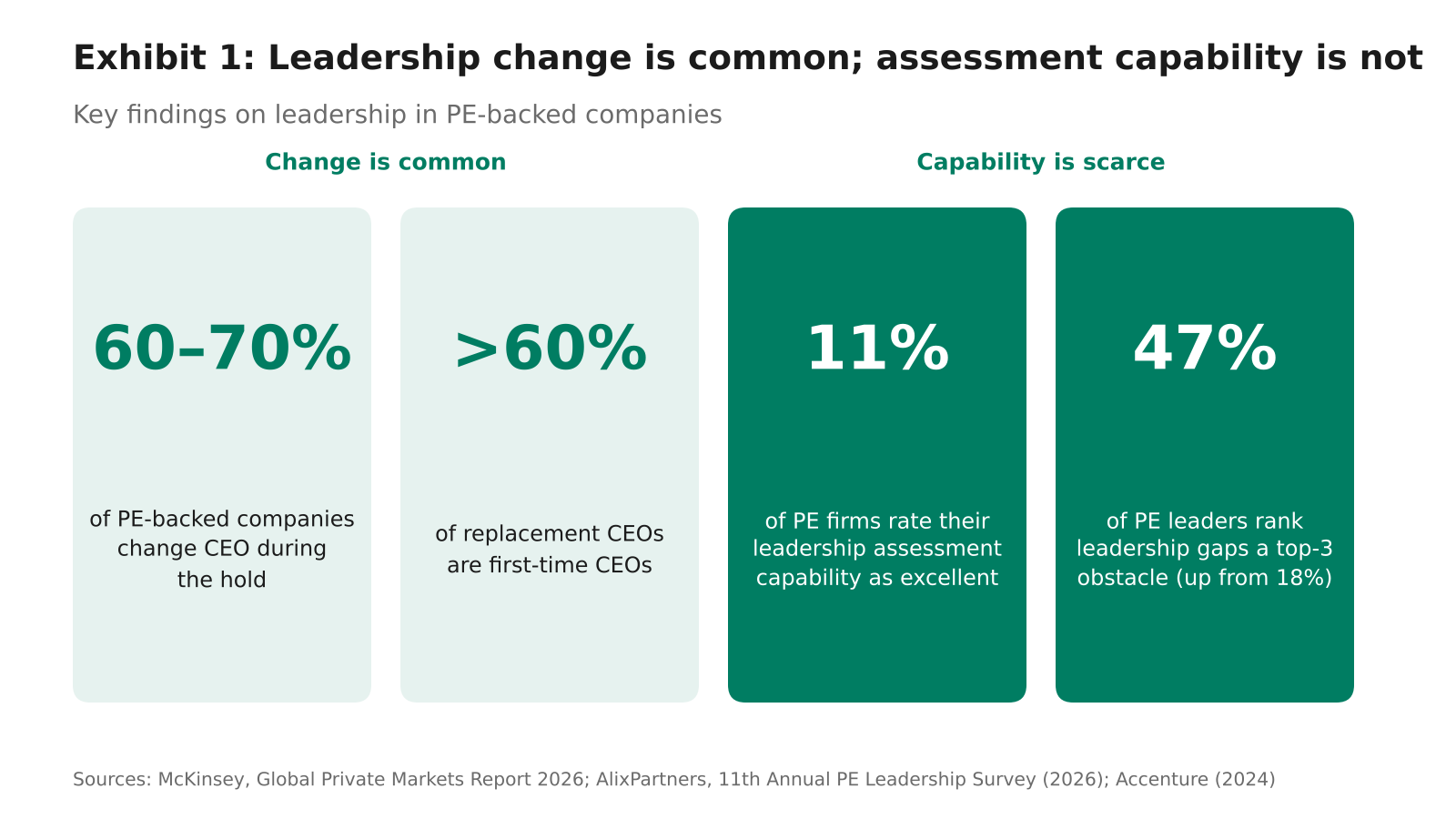
If leadership is the lever, investors are pulling it often. Between 60% and 70% of PE-backed companies change their CEO during the hold, and more than 60% of the replacements are first-time CEOs (McKinsey, 2026). AlixPartners finds 92% of unplanned CEO exits are decided by the PE firm, and 65% of CEO turnover happens during the hold rather than at entry.
The pattern is long-standing. A study of 66 UK buyouts found 39% of CEOs and 33% of CFOs were replaced before closing or within the first 100 days (Acharya, Kehoe and Reyner, 2008).
The question is not whether leadership will change. It is whether that change is anticipated, evidenced and fast.
The capability gap behind the decisions
Here lies the problem. Only 11% of PE firms, and just 8% of portfolio companies, rate their leadership assessment capability as excellent (AlixPartners, 2026). Meanwhile, 47% of PE leaders now rank portfolio leadership gaps among their top three obstacles to value creation, up from 18% a year earlier (Accenture).
Investors know they need to act faster: 85% of operating partners say they must address poorly performing executives more quickly (Blue Ridge Partners, cited by PEI). And formal assessment has become standard practice, with 97% of PE firms now using external interviewers or formal tools to evaluate CEOs, up from 61% in 2018 (AlixPartners and Heidrick & Struggles, 2025).
But using a tool is not the same as running a rigorous process. Many human capital leads still mainly administer psychometrics rather than build a full, triangulated view of each leader. And investors and their portfolio companies often want different things: 53% of PE firms prize “execution focus” in leaders, against 27% of portfolio companies, a perception gap that creates friction from day one.
What leading investors do differently
1. Treat leadership as part of the investment thesis. Assess the team during diligence and be ready to act on Day 1, not after the first missed quarter.
2. Assess with rigour, and triangulate. Psychometrics should inform people decisions, never solely determine them. Combine them with structured interviews, 360 input and hard performance evidence.
3. Decide faster, but on evidence. Speed matters, but a poorly evidenced replacement can cost more than the problem it was meant to solve.
4. Develop as well as select. With most replacement CEOs new to the role, McKinsey warns that “development often comes second to selection, a missed opportunity”. Coaching, mentoring and a clear development plan protect the investment in a new leader.
5. Build the bench before you need it. Only 43% of PE firms, and 29% of portfolio companies, have a CEO successor identified (AlixPartners, 2026). Succession should be a standing board topic, not an emergency.
The bottom line
When financial engineering no longer delivers the return, the quality, fit and alignment of leaders becomes the largest lever an investor controls. The firms that win the next cycle will assess leaders with the same rigour they apply to the numbers.
Talent Impacts helps investors, lenders and boards assess, develop and secure the leaders their value creation plans depend on. Get in touch to discuss how we can help.