
Part 3: The People Side of Restructuring
Lenders, investors and boards agree on one thing: no capital will be committed without a management team that can deliver a turnaround. Most organisations are not ready.
The overlooked finding
Restructuring reports tend to focus on maturity walls, leverage multiples and legal tools. Read the 2026 research closely, however, and a more human conclusion emerges. The deciding factor in whether a company secures support is increasingly the quality of its leadership.
Oliver Wyman concludes that no financing source will commit capital without a credible plan, a management team with genuine turnaround capability and professional liquidity management.
EY-Parthenon’s workout bankers rank shareholder support and a credible, executable business plan as their two most important criteria for supporting a borrower.
90% of restructuring experts want lenders to act as a strategic partner or a critical advisor, not simply a source of cash.
A plan is only as credible as the people expected to execute it.
Why the leadership bar has risen
Turnarounds now demand more than financial engineering. Every report makes the same point: balance-sheet fixes buy time, but only operational change creates value. That requires leaders who can reshape cost bases, exit underperforming businesses and rebuild competitiveness, often simultaneously.
Stakeholders are more numerous and more demanding. Capital structures now mix banks, direct lenders and special situations funds, each with different horizons. Leaders must align them around one endgame while keeping employees, customers and suppliers on side.
The window for action is shorter. Lenders are intervening earlier and are more willing to take control. Management teams that hesitate risk losing the right to lead.
The talent market is already responding
The capital side is investing heavily in people. Teneo reports that private lenders are building in-house workout and restructuring teams. Deloitte’s tracker, drawing on Waterman Stern’s data, lists dozens of senior and mid-level moves across private credit in just two quarters, with banks a major source of talent. Oliver Wyman’s experts rank relevant restructuring experience on both sides and process management by an appointed Chief Restructuring Officer among the factors that make lender collaboration succeed.
If lenders are upgrading their benches, borrowers must do the same.
What great turnaround leadership looks like
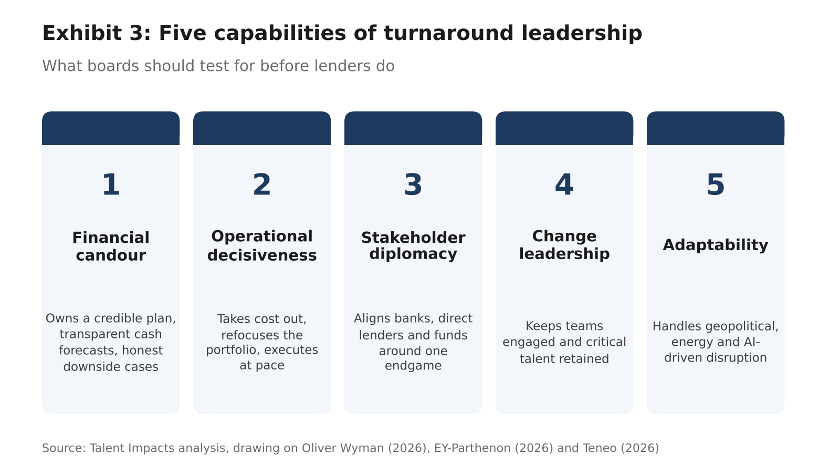
Drawing on these findings, we see five capabilities boards should test for:
Financial candour. The ability to build and own a credible plan, with transparent cash forecasting and honest downside scenarios.
Operational decisiveness. A record of taking costs out, refocusing portfolios and executing at pace.
Stakeholder diplomacy. Experience negotiating with multiple creditor groups and holding them to a shared outcome.
Change leadership. The capacity to keep teams engaged and talent retained through uncertainty.
Adaptability. Comfort with geopolitical shocks, energy volatility and AI-driven disruption to the business model.
What boards should do now
Assess leadership before lenders do. An honest review of the executive team’s turnaround capability is as important as an independent business review of the numbers.
Strengthen early. Bring in interim or permanent turnaround expertise, such as a CRO or transformation director, while the company still controls the timing.
Protect critical talent. Identify the people the plan depends on and secure them before uncertainty drives them away.
Build bench strength. Develop the next layer of leaders who will run the business once it has stabilised.
The bottom line
Capital follows conviction, and conviction follows people. In this restructuring cycle, the companies that emerge stronger will not simply be those with the best balance sheets, but those with leaders that lenders, investors and employees believe can deliver.
Talent Impacts helps boards and investors assess, strengthen and secure the leadership needed to navigate transformation. Get in touch to discuss how we can help.
Sources: Oliver Wyman, Restructuring Report 2026; EY-Parthenon, Restructuring Pulse Survey H1 2026; Teneo, The New Restructuring Landscape (June 2026); Deloitte, Private Debt Deal Tracker Europe, Spring 2026.