
Part Two: Capital Follows Conviction
Banks are retreating and private credit is stepping in. But the new lenders are more selective than the headlines suggest, and they will fund a plan, not a problem.
Two markets moving in opposite directions
European corporates face a widening funding gap. Oliver Wyman’s 2026 Restructuring Report finds 61% of financiers plan to cut their risk appetite over the next three years, up from 46% a year earlier. Not one expects to increase it. Meanwhile, half of corporate respondents describe their company as in an earnings crisis or worse, the highest figure the survey has recorded.
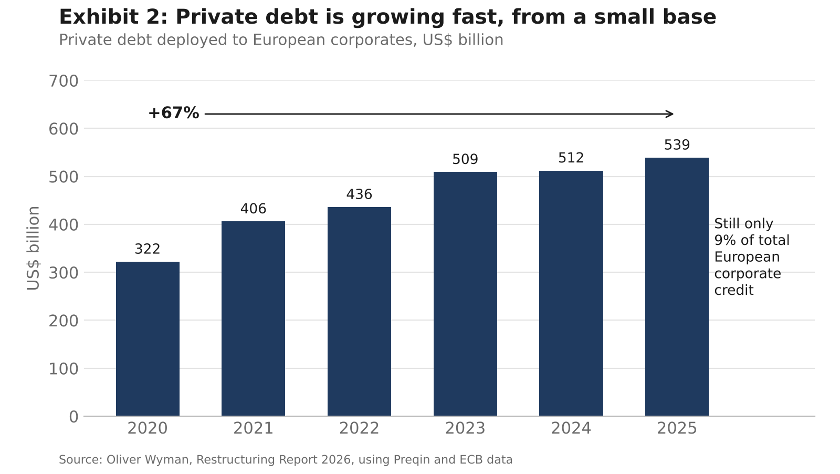
Private credit is filling part of the gap. European-focused private debt assets have grown 67% since 2020, and Deloitte tracked 551 private debt deals in the second half of 2025, including a record fourth quarter. Over 80% of restructuring experts now see private debt as a viable source of financing.
Yet private debt still represents only 9% of European corporate credit. And 39% of experts would use it only if bank debt were unavailable. It is a growing complement, not yet a replacement.
The paradox: appetite rising, cracks appearing
The data tells two stories at once.
In new deals, risk appetite is climbing. Deloitte reports 54% of deals in 2025 exceeded 4.0x leverage, up from 32.5% a year earlier, while margins tightened. Competition for good assets is fierce.
In existing portfolios, stress is building. Data cited by Teneo shows around 14% of private credit borrowers do not generate enough EBITDA to cover interest, and roughly 10% of loans carry payment-in-kind features that can mask distress. High-profile failures, including First Brands and Market Financial Solutions, have raised questions about transparency and governance. The Bank of England launched a system-wide scenario on private markets in December 2025.
The result is a market that is open for strong businesses and increasingly closed for weak ones. Teneo calls it private credit’s first real stress test.
What private lenders bring, and what they expect
Private debt funds are rated ahead of banks on speed, flexibility, problem-solving and their willingness to challenge management. Banks remain stronger on risk assessment, sector knowledge and access to crisis advisors.
When the two work together, the benefits are clear: shared risk and upside, faster restructurings and funding for situations banks alone would decline. But the partnership breaks down most often when there is no shared endgame, cited by 47% of experts, or when security structures become too complex.
Lenders are also changing how they behave:
Earlier intervention. Lenders are engaging sooner when performance dips, and many are building in-house workout teams.
Willingness to take control. Teneo finds private lender equitisations in Europe grew fourfold between 2019 and 2025.
Sharper scrutiny of AI risk. Deloitte notes credit committees now run AI-defensibility assessments on new deals and existing portfolios.
What this means for boards and owners
Lead with the plan, not the ask. The single most important success factor in lender collaboration is a robust restructuring concept and credible financial planning by the borrower (Oliver Wyman). EY-Parthenon’s workout bankers rank shareholder support and an executable business plan as their top criteria.
Commission an independent business review early. Transparency established on your terms builds credibility; transparency forced by lenders erodes it.
Align the capital structure around one endgame. Recovery, sale or managed wind-down: lenders will tolerate many paths, but not a lack of one.
Know your lenders. A bank, a direct lender and a special situations fund have different time horizons, costs and motives. Strategy must reflect who sits in the capital stack.
The bottom line
Capital has not disappeared; it has become discerning. As Oliver Wyman puts it, capital, regardless of its source, follows conviction. The companies that secure it will be those that can show a credible plan and the leadership to deliver it.
A plan is only half of what lenders are backing. The other half is the team that will execute it. Talent Impacts helps boards and investors test whether their leadership is ready to earn that conviction, and strengthen it where it is not. Get in touch to discuss how we can help.
Sources: Oliver Wyman, Restructuring Report 2026; Deloitte, Private Debt Deal Tracker Europe, Spring 2026; Teneo, The New Restructuring Landscape (June 2026); EY-Parthenon, Restructuring Pulse Survey H1 2026.