
Part One: The Long Cycle
Distress has been deferred, not avoided. As the refinancing wall arrives, the window for buying time is closing, and early action is now the most valuable decision a board can make.
The cycle that keeps moving the finish line
Europe’s restructuring cycle is proving longer than almost anyone predicted. In EY-Parthenon’s latest Restructuring Pulse Survey of 246 workout bankers, 60% reported that activity rose in the second half of 2025 and 73% expect it to rise again in 2026. For the second survey running, the expected peak has slipped by six months, now to the second half of 2026. More than a fifth do not expect it until 2027.
This is not a short, sharp correction. It is a slow build of pressure with no single trigger and, so far, no release valve.
A note on timing. The surveys behind this analysis were run in early 2026. As we publish in autumn 2026, Europe is now inside the window that bankers identified as the likely peak, which makes the decisions boards take over the next two quarters especially consequential.
Three forces are stretching the cycle
Buffers delayed the reckoning. Many companies entered this period with strong liquidity and cheap, long-dated debt. That cushion postponed distress rather than removing it.
Shocks keep overlapping. Energy and raw-material costs are now the number one restructuring trigger, cited for 25% of portfolios, ahead of slower growth (17%) and falling sales (15%). Conflict in the Middle East has added fresh supply-side and energy pressure. EU electricity prices remain around 60% above their 2015 level, according to Oliver Wyman.
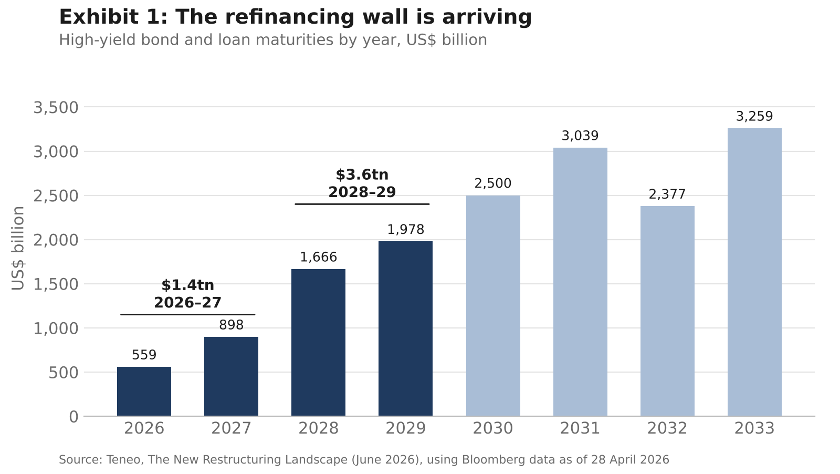
The maturity wall has arrived. Teneo estimates more than $1.4 trillion of high-yield debt matures in 2026–27, and a further $3.6 trillion in 2028–29. Deloitte’s deal data confirms that refinancings of 2021–22 facilities are already a notable share of activity. Much of this debt was underwritten at near-zero rates; it must now be refinanced at materially higher ones.
The end of “extend and pretend”
For three years, amend-and-extend (A&E) deals have been the market’s default tool. They remain the most common solution, and for performing businesses they can be smart corporate finance. For stressed businesses, however, the limits are showing.
Teneo’s analysis is blunt: out-of-court fixes work only when paired with genuine operational improvement. Where the problem is structural, such as a broken business model or permanently higher input costs, A&E simply delays a deeper restructuring. Cases such as Keter, Oriflame and Thames Water show how quickly a holding pattern can turn into creditor control or a full recapitalisation.
Pressure from investors for exits, finite fund lives and the maturing of 2019–21 vintage loans mean lenders can no longer defer losses indefinitely.
Where the pressure is concentrated
Momentum has shifted decisively from Eastern to Western Europe. Over 80% of Western European respondents expect activity to rise, led by Germany, France and the UK.
Automotive leads for the third consecutive survey, with tier 2 and 3 suppliers squeezed by Chinese competition, US tariffs and slow EV adoption.
Manufacturing and chemicals face energy costs, weak demand and heavy investment needs.
Agriculture has moved into focus as fertiliser, energy and logistics costs climb.
In the UK, chemicals and construction lead, with hospitality and leisure more prominent than elsewhere in Europe due to rising wage bills and softer consumer demand.
What leaders should do now
Act before liquidity forces the issue. Many companies wait until covenants or cash run short. By then, options have narrowed and lenders are already assessing insolvency scenarios. Build 13-week cash visibility and downside scenarios today.
Separate the cyclical from the structural. Be honest about which problems a refinancing will solve and which it will only postpone.
Pair the balance sheet fix with business transformation. Cost discipline, portfolio pruning and a sharper focus on resilient segments are what convert extra time into lasting value.
Plan locally. Triggers differ by market: slower growth in Germany, energy in France and Spain, input costs and supply chains in the UK. One playbook will not fit all.
The bottom line
The question for most boards is no longer whether pressure will arrive, but whether they will act while they still have choices. In a long cycle, time is the asset that runs out first.
Leadership capacity runs out next. Acting early depends on people who can read the warning signs, take hard decisions and carry lenders and teams with them. Talent Impacts helps boards assess and strengthen that leadership before the market forces the question. Get in touch to discuss how we can help.
Sources: EY-Parthenon, Restructuring Pulse Survey H1 2026; Teneo, The New Restructuring Landscape (June 2026);Oliver Wyman, Restructuring Report 2026; Deloitte, Private Debt Deal Tracker Europe, Spring 2026.