
Direct lenders sit far closer to the companies they finance than banks do. When a sponsor steps back, the lender inherits not only the equity but the talent agenda, and the value it lent against depends on who runs the business.
Direct lenders are already close to the business
Private credit is often described as a substitute for bank lending. The research shows it behaves very differently, and much closer to an owner.
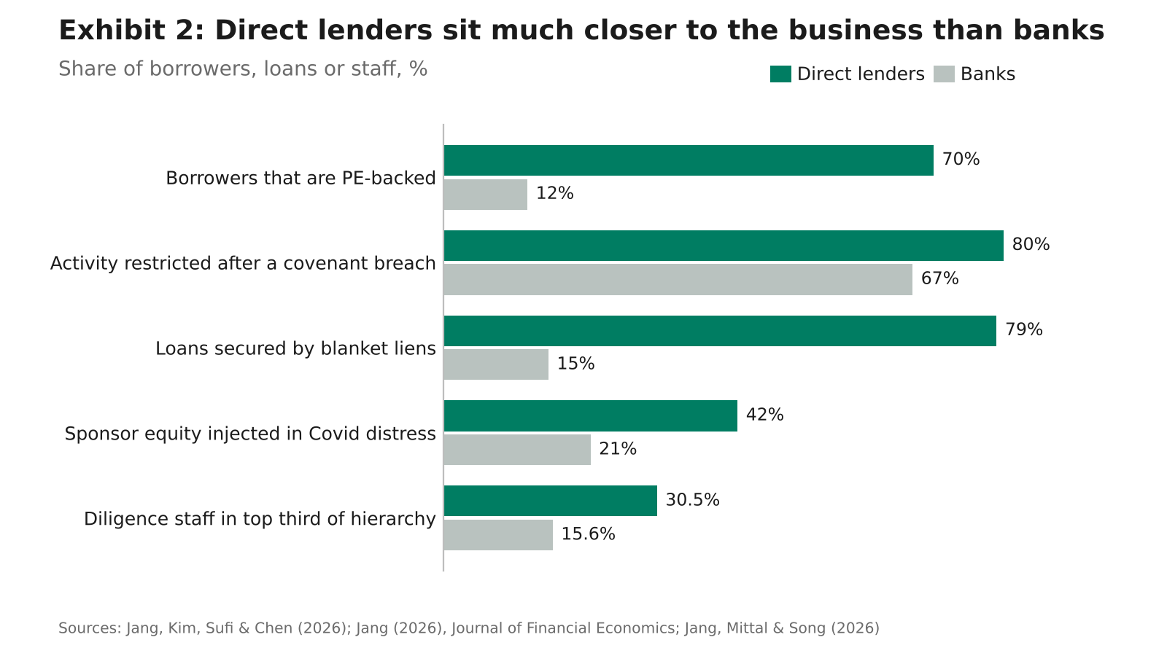
Their borrowers are sponsor-backed. Around 70% of direct lenders’ middle-market borrowers are PE-backed, against just 12% for banks (Jang, Kim, Sufi and Chen, 2026).
They hold tight controls. 98% of direct loans carry financial covenants, and after a breach, direct lenders restrict the company’s activity in 80% of cases, compared with 67% for banks (Jang, 2026, Journal of Financial Economics).
They join the board in distress. 35% of US and 29% of European private debt funds sit on portfolio company boards when a borrower is in distress (Block, Jang, Kaplan and Schulze, 2024).
They lend on the team
The most telling difference is what direct lenders lend against. 79% of direct loans use blanket liens, against 15% of bank loans. In other words, direct lenders lend on the continuation value of the business as a going concern, not on a narrow pool of assets.
A going concern is only as valuable as the people who keep it going. Continuation value rests on the management team, and direct lenders behave accordingly: 30.5% of private credit diligence staff sit in the top third of their organisation’s hierarchy, nearly double the 15.6% at banks (Jang, Mittal and Song, 2026). Senior eyes are on management from the start.
Sponsor support matters, until it stops
When a borrower runs into trouble, the sponsor is the first line of defence. During the Covid distress, 42% of direct-lending borrowers received sponsor equity injections, against 21% of bank borrowers, and bankruptcy rates were 2% versus 15% (Jang, 2026). Sponsor equity support lowers credit risk and helps resolve distress (Haque, Jang and Mayer, 2026).
But when the sponsor declines further support, that role does not disappear. The capital, the governance and the leadership decisions pass to the lender. As we noted in an earlier article, private lender equitisations in Europe grew fourfold between 2019 and 2025 (Teneo). More lenders are taking the keys, and with them, the people questions:
Is this the right CEO and CFO for the recovery plan, not the original buyout plan?
Does the board have the skills and independence the situation now requires?
Which critical people are at risk of leaving, and what will it take to keep them?
The playbook is still being written
There is an honest gap in the evidence. The research shows clearly how closely direct lenders monitor and govern their borrowers, but none of the studies we reviewed measures what happens to talent after a lender takes control. Lenders are, in effect, writing the post-keys playbook in real time.
That makes discipline more important, not less. The sponsor world has learned, sometimes painfully, that leadership decisions made late or on thin evidence destroy value. Lenders have the chance to learn from that experience rather than repeat it.
What lenders should do now
Read the C-suite before the keys. Use credit-team contact and board observer rights to form an early view of leadership quality on the watchlist.
Pre-qualify an interim bench. Know which interim CEOs, CFOs, CROs and Chairs you could call on before you need them.
Stage the assessment for Day 1. Have psychometrics, interviews and a board diagnostic ready to start as soon as control changes.
Make leadership part of the revised value creation plan. Every C-suite and critical role should have a named decision and an owner.
Build capability or bring it in. Many lenders are building in-house workout teams; the people dimension needs the same specialist attention as the balance sheet.
The bottom line
For a direct lender, management quality was always a credit question. Once the sponsor steps back, it becomes an ownership question. The lenders that recover most value will be those that treat the talent agenda with the same rigour as the capital structure.
Talent Impacts helps lenders and investors assess, stabilise and strengthen leadership through restructuring and beyond. Get in touch to discuss how we can help.
Sources: Jang (2026), Journal of Financial Economics; Jang, Kim, Sufi and Chen (2026), The lending technology of direct lenders; Jang, Mittal and Song (2026), Organization of human capital in corporate lending; Block, Jang, Kaplan and Schulze (2024), A survey of private debt funds, Review of Corporate Finance Studies; Haque, Jang and Mayer (2026); Teneo, The New Restructuring Landscape (2026).